
Welcome to Holger Mitterer's Website!

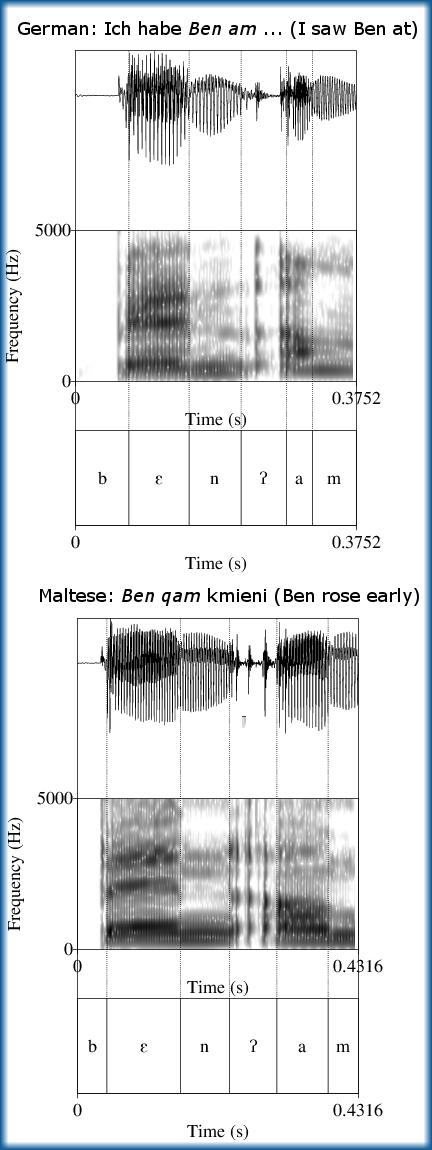
I am currently a staff member at the Max Planck Institute for Psycholinguistics in the Language Comprehension Group. My research focuses on ecological aspects of speech perception. That is, how can we perceive the speech in real life with all its variation due to the speaker (e.g., Mitterer, 2006a, Phonetica) and the phonetic context in which a word or segment appears (Mitterer, 2006b, Perception & Psychophysics). My interest in speech perception also lead to forays into other domains, such as speech production (Mitterer, & Ernestus, 2008) and colour perception (Mitterer & de Ruiter). On this page, you'll find a short bio and some "featured" research.
I got to the MPI via -- in reverse order -- Maastricht (Ph.D), Bielefeld (Germany) & Leiden (The Netherlands, Master in Psychology), and the Rhein-Main area around Frankfurt in Germany (born & raised). Along the way, I picked up a passion for (in no particular order) science, salsa music, and endurance sports. The last passion brings me to spend time on the road in summer, and on snow or ice in the winter.


Research Examples

Improve your second-language listening skills

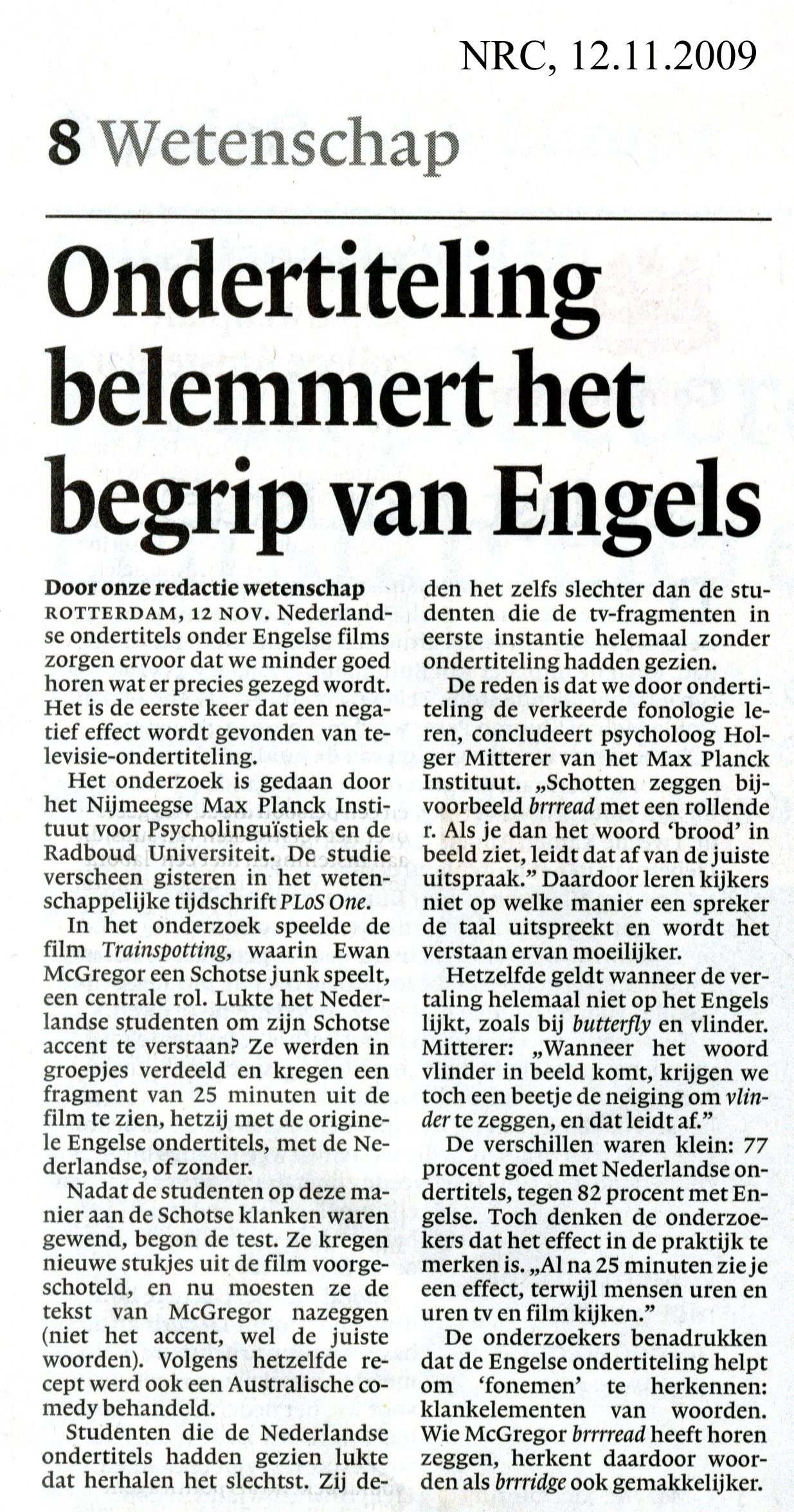
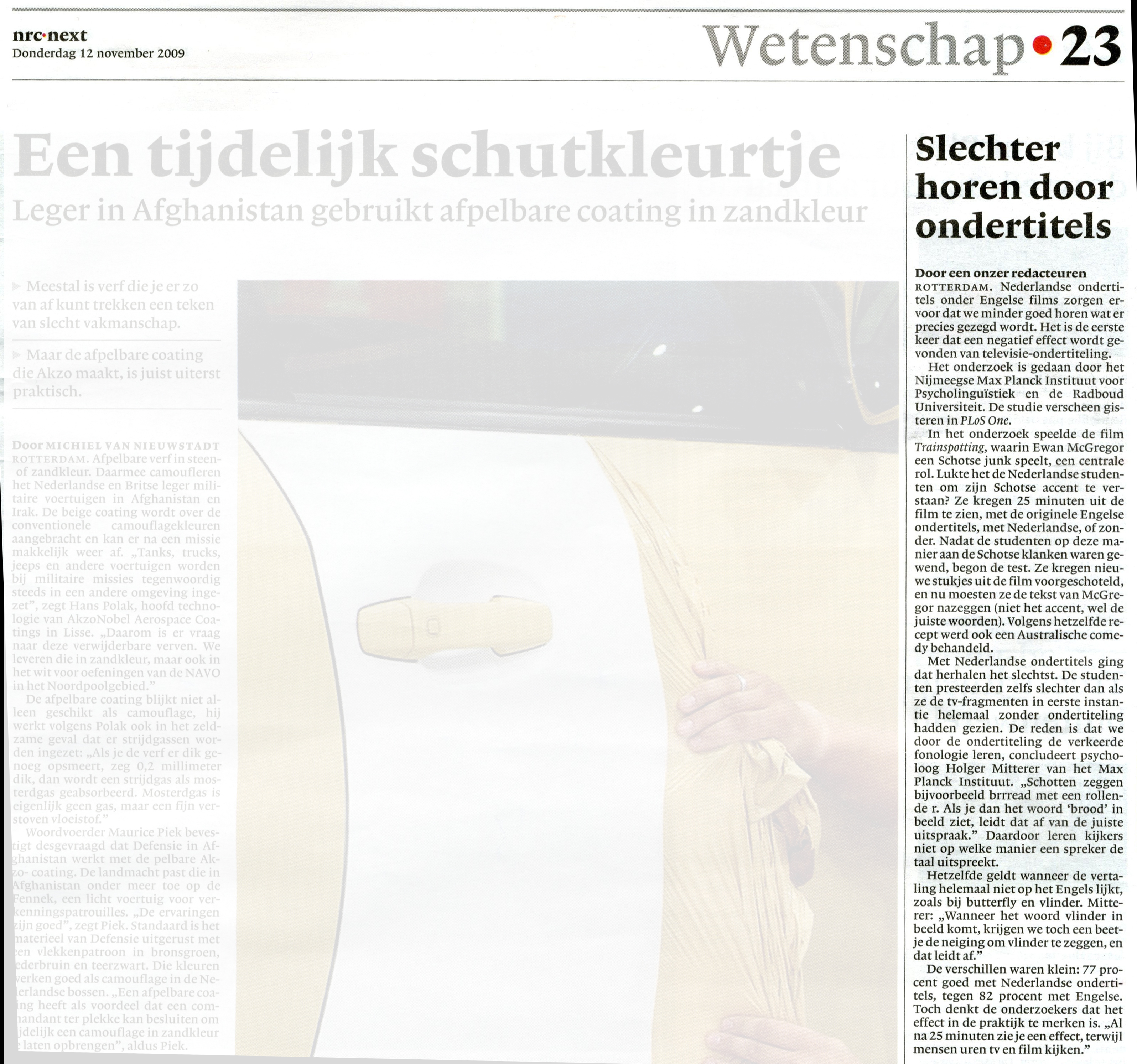
Do you speak English as a second language well, but still have trouble understanding movies with unfamiliar accents, such as Brad Pitt's southern accent in Quentin Tarantino's Inglourious Basterds? Or indeed, Ewan McGregor's Scottish accent in Trainspotting? In a study, published in PLoS ONE on November 11, 2009, we (James McQueen and I) show how you can improve your second-language listening ability by watching the movie with subtitles--as long as these subtitles are in the same language as the film. Subtitles in one's native language, the default in some European countries, may actually be counter-productive to learning to understand foreign speech.

We show for the first time that listeners can tune in to an unfamiliar regional accent in a foreign language. Dutch students showed improvements in their ability to recognise Scottish or Australian English after only 25 minutes of exposure to video material. English subtitling during exposure enhanced this learning effect; Dutch subtitling reduced it. So the next time you watch a DVD in a foreign language, and you want to improve your listening skills, you know what to do.

An interesting point to be made here is that this applied finding came out of a long series of papers on fundamental research on speech perception. As it turns out a good theory is quite practical indeed.


Testing ambiguity without ambiguity

Often we want to test the perception of ambiguous speech signals, but we don't want our participants to be confused about what they should do. A solution to this paradox is to use eye-tracking with instructions that are temporally ambiguous. Look at the picture at the right. If you are asked to click on the word "bul" above the star, it's clear what you have to do. However, when you've just heard "click on the word bul ...", it's still ambiguous, because the alternative target "bult" is often pronounced without a /t/ (Yes, Germans don't believe that, but it's still true). With this design, we (me and my colleague James McQueen) found that listeners look more at the word "bult" when hearing "bul" if the phonological context makes the reduction of the /t/ more likely.

This fits nicely with what I had found in my dissertation. Listeners also take the phonological context into account when hearing so called "assimilated" words, such as garden produced as "gardem". The spaceships on the right are actually on the cover of this dissertation. If you are unsure why, read this.